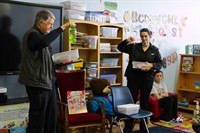
Story time guests teach families about dental hygiene
Dentist Robert Niles and dental hygienist Susan McPherson from the health department visited the Smart Start Early Learning and Family Resource Center (ELF) for National Children's Dental Health Month and to speak with the families about dental hygiene.
McPherson read a book about dental hygiene, then she and Niles lead the children in a game to see if they could identify what foods are good and what foods are bad for their teeth.
They answered questions from parents and warned them about the dangers of baby bottle syndrome, also known as baby bottle tooth decay, which occurs when babies routinely fall asleep with a bottle in their mouth containing sugary drinks like milk and juice. Breastfed babies are also at risk if they fall asleep while feeding.
“Lots of times we’ll see kids come in – we saw one the other day – who just have no upper front teeth because they’d been given a bottle continuously to go to bed,” Niles told parents.
Niles and McPherson advised that for children who use a bottle for comfort at night, only water should be in the bottle to prevent tooth decay and potential loss of baby teeth.
A common misconception among parents, they said, is that losing baby teeth prematurely is not a big deal; however, these teeth serve as important placeholders for a child’s permanent teeth. Without them, children can experience a collapse of the dentition, orthodontic problems, teeth that come up the wrong way or are blocked from emerging.
Baby teeth that have decay can cause infection inside the bone, and can even damage the permanent teeth beneath them, Niles said.
Parents asked when they should start brushing and what they should use. Niles said a toothbrush or a cloth would suffice but noted that rinsing alone is not enough.
“Plaque is a very sticky material,” he said. “I use the analogy for a lot of patients that if you take a can of motor oil and pour it on your windshield and then try to get it off with a garden hose, it doesn’t work so well. You’ve got to physically scrape that oil off your windshield. Plaque is the same way. It’s not soluble in water. You can’t rinse it out. You have to mechanically scrape it off.”
Parents should start cleaning their child’s mouth even before their baby teeth erupt.
“It’s important for the child to have a clean, healthy mouth even before the teeth erupt,” Niles said. It’s also important for the child to learn that things need to go in the mouth to keep things clean, whether it’s a brush or it’s a cloth. The earlier you can get them used to putting things in their mouth and moving them around, the better, the easier it’s going to be to transition to oral hygiene and flossing.”
If a parent finds that their child is fussy when they try to brush their teeth, Niles suggested making them comfortable by sitting on the living room sofa with their child’s head on the parent’s lap while they brush.
In addition to brushing, children should begin seeing a dentist as soon as they have teeth, McPherson said.
After Niles and McPherson left, the children completed a craft – a mouth full of teeth made from cardstock and marshmallows.